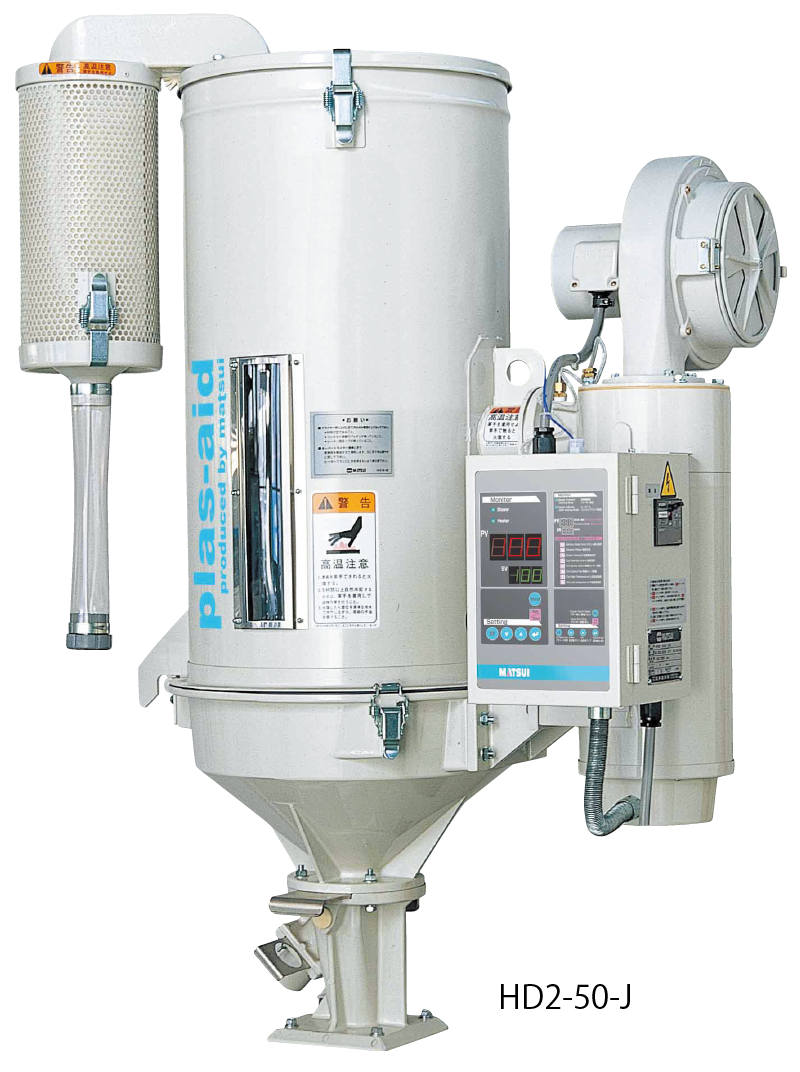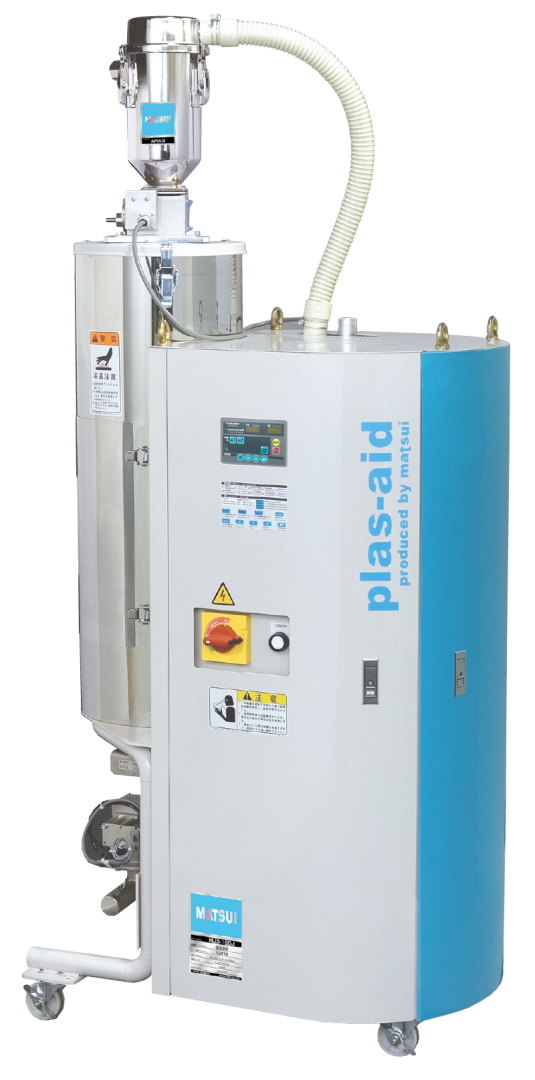
What is Hot Air Dryer?
A resin Hot Air Dryer is a drying device that uses a heater to heat outside air and then sends the hot air into a drying hopper to evaporate and remove the moisture in the resin.
This is a simple drying method in which heated air is circulated into the drying hopper by a blower, and because it uses a structure that directly heats outside air, the device configuration is simple and its major feature is that it is easy to keep installation costs down.As it does not have Dehumidifying Unit, it can be installed relatively inexpensively in terms of both initial and maintenance costs, and is widely used for pre-drying and standard drying purposes.
It is mainly suitable for resin materials with low moisture absorption, such as polyethylene (PE) and polypropylene (PP), or ABS resin, which can be dried at low temperatures of around 70 to 80°C.

On the other hand, for applications requiring highly hygroscopic resin materials or strict moisture control, selecting a more efficient drying method such as Dehumidifying Dryer can be expected to further improve molding quality.
Features
1. Stable control achieved by using SSR (contactless relay)
The heater control circuit uses an SSR (contactless relay). Because it is a semiconductor relay with no physical contacts, it is less susceptible to contact wear and poor contact, enabling stable control. This improves the reliability of heater control, reduces maintenance frequency, and contributes to improved safety.
Another feature is that the structure has no moving parts, resulting in a longer lifespan than conventional contact relays. Designed for a contact life of 10 years or more, this reduces maintenance burden and ensures stable operation over long periods of time.

By the way, a contact relay (mechanical relay) is a relay type that uses the power of an electromagnet to mechanically operate a switch.
It is typically used in larger equipment such as electric motors.
2. Double hopper provides reliable drying quality
A double-type hopper with a space between the inside and outside of the hopper is used. This structure makes it less susceptible to the effects of outside temperature, ensuring stable drying quality regardless of the season or weather.
In addition, the excellent insulation effect of the double structure keeps the temperature inside the hopper constant, which results in improved drying efficiency and uniform drying, and also reduces heat radiation to the outside, contributing to reduced energy loss.
3. Space-saving design with integrated drying and transportation
By integrating the drying process and the resin material transport process and reviewing the overall structure of the equipment, we have achieved a significant reduction in size.Since the dried resin material can be supplied directly to the molding machine, piping and installation space between the equipment can be reduced, improving layout flexibility.
Furthermore, by consolidating equipment, it is possible to simplify installation work, wiring and piping work, and also reduce the burden of daily inspections.The design makes effective use of limited factory space, achieving both space savings and improved work efficiency.
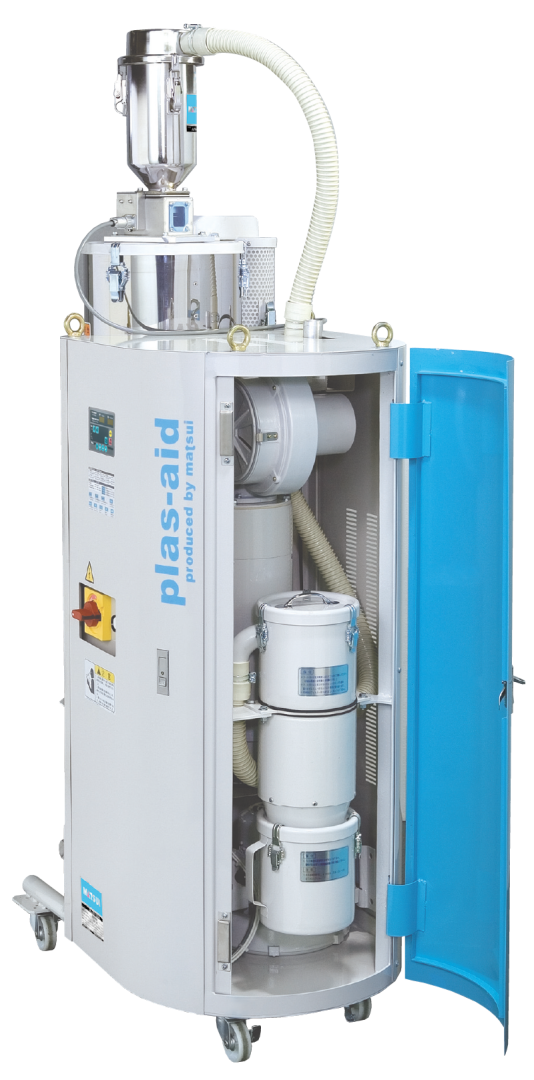
4. Excellent maintenance design
Maintainability has been significantly improved by reviewing the device design. The filter section can be accessed simply by opening the door, allowing daily filter maintenance to be performed without the use of tools.
This not only reduces the time required for inspection and cleaning, but also reduces the burden on workers. Regular filter maintenance can be easily performed, making it easier to maintain stable equipment performance and contributing to long-term stable operation.